

Registered under the Ministry of MSME, Govt of India)
Reg No: UDYAM-TN-24-0132020
HYBRID INTERNSHIP IN COUNSELLING & PSYCHOTHERAPY
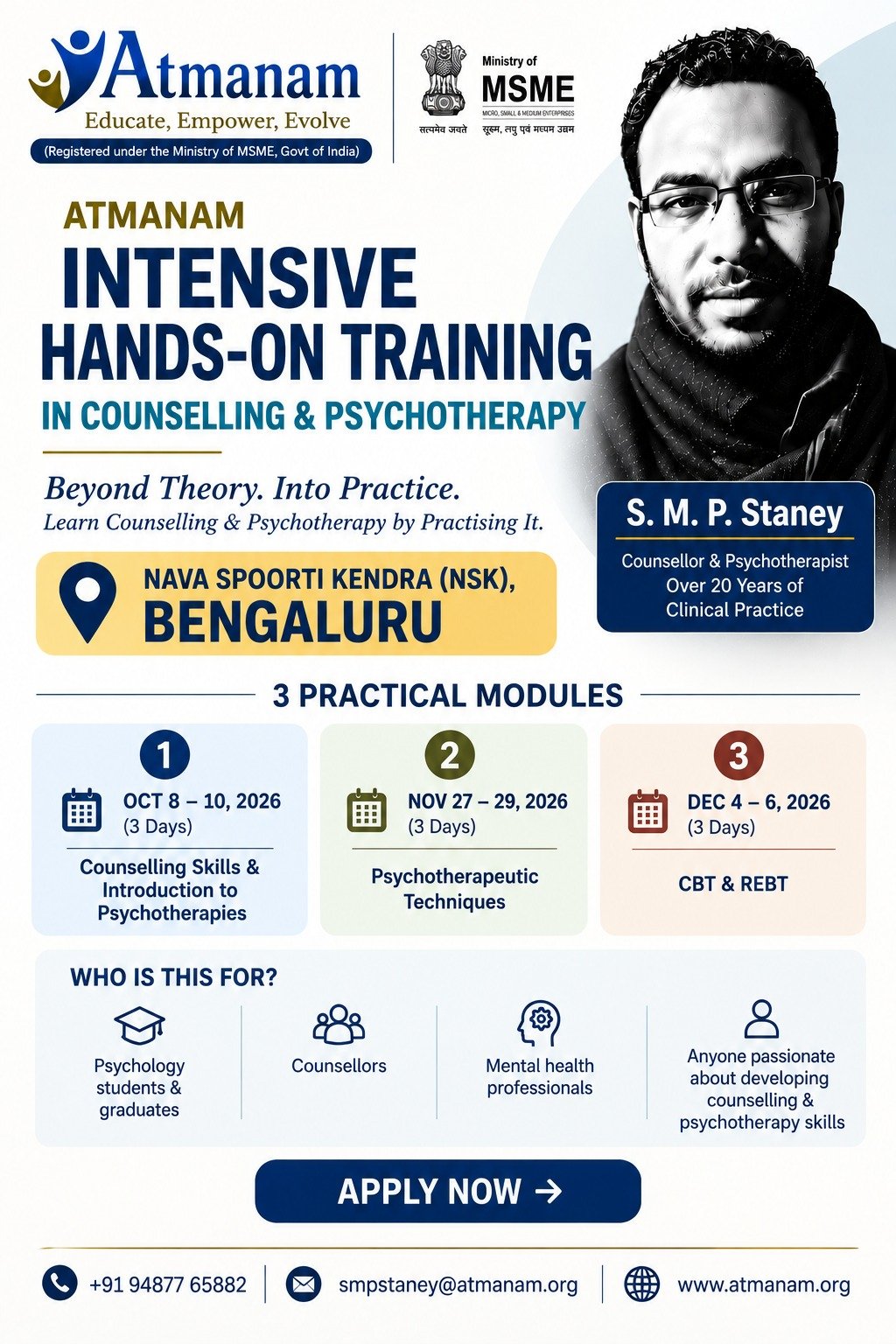
INTENSIVE HANDS-ON TRAINING IN COUNSELLING & PSYCHOTHERAPY
Beyond Theory. Into Practice.
PROGRAMME OVERVIEW
The ATMANAM Hybrid Internship in Counselling & Psychotherapy is a comprehensive competency-based professional training programme designed to bridge the gap between academic knowledge and real-world counselling and psychotherapy practice.
The programme combines intensive experiential practicum with structured online theoretical learning, enabling participants to develop the knowledge, skills, attitudes and professional identity required for ethical counselling and psychotherapy practice.
Unlike conventional certificate programmes, participants learn through live cases, demonstrations, supervised practice, case discussions, experiential learning and reflective practice.
The emphasis is on moving beyond simply knowing psychological theories to understanding how a counsellor observes, thinks, formulates a case, selects an intervention and works with a client in practice.
PROGRAMME STRUCTURE
180 HOURS
4 PROGRESSIVE MODULES
2 PHASES
The programme is structured in two progressive phases.
PHASE I
Intensive Practicum
Modules 1, 2 & 3
PHASE II
Online Foundation & Theoretical Integration
Module 4
The structure allows participants to develop practical counselling and psychotherapy skills through intensive experiential training and subsequently consolidate their learning through structured theoretical study.
PHASE I
INTENSIVE PRACTICUM
MODULES 1, 2 & 3
9 Days of Intensive Hands-on Training
October – December 2026
VENUE
Nava Spoorti Kendra (NSK)
Bengaluru
The practicum is the experiential core of the ATMANAM Internship.
Participants learn through live cases, live demonstrations, case discussions, guided practice, supervised practice and individual feedback.
MODULE 1
COUNSELLING SKILLS & INTRODUCTION TO PSYCHOTHERAPIES
8–10 OCTOBER 2026
BENGALURU
OBJECTIVE
To develop practical counselling skills and introduce participants to the major approaches to psychotherapy.
The module focuses on understanding the counselling process, developing a therapeutic relationship and learning how a counsellor observes and understands a client's presenting problem.
LEARNING AREAS
COUNSELLING SKILLS
- Therapeutic Communication
- Active Listening
- Empathy
- Observation Skills
- Questioning Skills
- Reflection Skills
- Building the Therapeutic Relationship
UNDERSTANDING THE CLIENT
- Understanding presenting problems
- Client narratives
- Behaviour patterns
- Emotional processes
- Identifying underlying concerns
- Understanding the person within context
THERAPEUTIC RELATIONSHIP
- Therapeutic presence
- Professional boundaries
- Developing rapport
- Understanding the counsellor's role
- Creating a safe therapeutic environment
CASE UNDERSTANDING
- Observing client presentations
- Identifying psychological patterns
- Generating hypotheses
- Introduction to case formulation
- Understanding possible therapeutic directions
INTRODUCTION TO PSYCHOTHERAPY
Participants are introduced to different therapeutic perspectives and how they understand psychological problems and psychological change.
PRACTICAL LEARNING
- Live demonstrations
- Live case discussions
- Guided practice
- Experiential exercises
- Observation and analysis
- Group reflection
- Supervised learning
LEARNING OUTCOME
Participants develop greater confidence in engaging in therapeutic conversations, observing client presentations and approaching counselling situations from a professional perspective.
MODULE 2
PSYCHOTHERAPEUTIC TECHNIQUES
27–29 NOVEMBER 2026
BENGALURU
OBJECTIVE
To develop practical psychotherapy skills through demonstrations, guided practice, experiential learning and supervised application.
Participants learn how therapeutic techniques are selected and adapted according to the client's needs and therapeutic context.
LEARNING AREAS
GESTALT & EXPERIENTIAL TECHNIQUES
- Empty Chair
- Chair Work
- Focusing
- Therapeutic Experiments
BEHAVIOURAL TECHNIQUES
- Exposure Techniques
- Systematic Desensitisation
- Behaviour Modification
EMOTION & IMAGERY WORK
- Emotion-Focused Techniques
- Imagery Techniques
- Anchoring
- Visual Kinesthetic Dissociation (VKD)
RELATIONSHIP & COUPLE WORK
- Couple Therapy Demonstrations
- Relationship Patterns
- Communication Patterns
EXPERIENTIAL INTERVENTIONS
- Therapeutic Experiments
- Experiential Techniques
- Understanding Emotional Processes
- Selecting Appropriate Interventions
PRACTICAL LEARNING
- Live demonstrations
- Case discussions
- Guided practice
- Experiential interventions
- Supervised practice
- Individual feedback
LEARNING OUTCOME
Participants develop greater confidence in understanding, selecting and applying psychotherapy techniques within appropriate therapeutic contexts.
MODULE 3
COGNITIVE THERAPIES
CBT & REBT
4–6 DECEMBER 2026
BENGALURU
OBJECTIVE
To develop practical competence in Cognitive Behaviour Therapy (CBT) and Rational Emotive Behaviour Therapy (REBT) through structured assessment, case formulation and intervention.
LEARNING AREAS
CBT
- Foundations of CBT
- Cognitive Model
- Automatic Thoughts
- Core Beliefs
- Cognitive Distortions
- Case Formulation
- Cognitive Restructuring
- Behavioural Techniques
- Homework Planning
- Worksheets
REBT
- Foundations of REBT
- ABC Framework
- Irrational Beliefs
- Rational Thinking
- Disputation
CASE-BASED APPLICATION
- Understanding the presenting problem
- Identifying cognitive and behavioural patterns
- Developing case formulations
- Connecting thoughts, emotions and behaviour
- Selecting appropriate interventions
- Applying structured therapeutic techniques
PRACTICAL LEARNING
- Live demonstrations
- Case discussions
- Guided application
- Case formulation
- Supervised practice
- Individual feedback
LEARNING OUTCOME
Participants develop practical competence in understanding cognitive and behavioural patterns, formulating cases and applying appropriate CBT and REBT interventions.
PHASE II
ONLINE FOUNDATION & THEORETICAL INTEGRATION
MODULE 4
FOUNDATIONAL THEORY
4–29 JANUARY 2027
Monday–Friday
7:00 PM–8:15 PM
Module 4 provides the theoretical framework required to understand and integrate the practical learning developed during the practicum.
OBJECTIVE
To consolidate participants' understanding of counselling, psychotherapy, human behaviour and psychological case formulation and connect theoretical concepts with their practical learning.
LEARNING AREAS
FOUNDATIONS OF COUNSELLING
- Understanding the Counselling Profession
- Roles & Responsibilities
- Ethics in Counselling
- Professional Boundaries
COUNSELLING SKILLS
- Therapeutic Communication
- Active Listening
- Empathy
- Observation Skills
- Questioning Skills
- Reflection Skills
UNDERSTANDING HUMAN BEHAVIOUR
- Psychological Development
- Personality
- Behaviour Patterns
- Emotional Processes
CASE CONCEPTUALISATION
- Understanding Client Problems
- Hypothesis Generation
- Case Formulation
- Treatment Planning
FOUNDATIONS OF PSYCHOTHERAPY
- What is Psychotherapy?
- Therapeutic Relationship
- Understanding Change
CBT & REBT FOUNDATIONS
- Cognitive Model
- ABC Model
- Basic Cognitive Interventions
LEARNING OUTCOME
Participants consolidate the theoretical knowledge necessary for counselling and psychotherapy practice and integrate this understanding with their practical experience.
LEARNING METHODOLOGY
The ATMANAM Internship adopts an experiential and competency-based learning approach.
Training methods include:
- Interactive learning
- Live demonstrations
- Live case discussions
- Experiential learning
- Guided practice
- Supervised practice
- Reflective learning
- Peer feedback
- Individual feedback
- Case analysis
- Field assignments
The emphasis is on learning through observation, practice, reflection and professional feedback.
CERTIFICATION REQUIREMENTS
Participants will be awarded certification upon successful completion of the programme requirements, including:
- Completion of Modules 1–4
- Attendance requirements
- Practical participation
- Practical demonstrations
- Reflective journal
- Assignments
- Field work
- Demonstration of learning and practical competencies
WHO SHOULD ATTEND?
The programme is suitable for:
- Psychology Students
- Psychology Graduates
- Counsellors
- Psychologists
- Mental Health Professionals
- Teachers & Educators
- Social Workers
- NGO Professionals
- Healthcare Professionals
- HR Professionals
- Individuals aspiring to develop professional counselling skills
The programme is particularly relevant for learners who want to move beyond theoretical knowledge and develop practical counselling and psychotherapy skills.
PROGRAMME HIGHLIGHTS
180 HOURS OF STRUCTURED LEARNING
9 DAYS OF INTENSIVE HANDS-ON PRACTICUM
3 PRACTICAL MODULES
BENGALURU-BASED PRACTICAL TRAINING
LIVE CASES & DEMONSTRATIONS
CASE DISCUSSIONS
SUPERVISED PRACTICE
EXPERIENTIAL LEARNING
INDIVIDUAL FEEDBACK
ONLINE THEORETICAL INTEGRATION
THINK SPACE LEARNING COMMUNITY
PROFESSIONAL CERTIFICATION
PROGRAMME FEE
STUDENTS
₹6,999 per Module
PROFESSIONALS
₹7,999 per Module
Participants may enrol module-wise.
ACCOMMODATION
BENGALURU COHORT
Accommodation can be arranged at Nava Spoorti Kendra for participants travelling from outside Bengaluru.
Single Room: ₹1,000 per day
Shared Room: ₹800 per day
Dormitory: ₹700 per day
Meals and refreshments included.
THE ATMANAM LEARNING JOURNEY
PHASE I
INTENSIVE PRACTICUM
Counselling Skills → Psychotherapeutic Techniques → CBT & REBT
↓
PHASE II
THEORETICAL INTEGRATION
Foundational Theory
↓
CONTINUED LEARNING
Think Space
The learning journey can continue beyond the internship through Think Space, ATMANAM's ongoing learning community for continued psychological learning and professional development.
ATMANAM
Centre for Counselling, Psychotherapy & Skills Training
Beyond Theory. Into Practice.
- M. P. Staney
Counsellor & Psychotherapist
Phone: +91 94877 65882
Email: smpstaney@atmanam.org
Website: www.atmanam.org
General: ₹7,999/- per module
Student Rate: ₹6,999/- per module
(Includes training materials, lunch, and refreshments)